What should be remembered?
Not every message deserves durable storage.
International AI Awards 2026 · Best AI Tool · Gold Winner
MAPI preserves decisions and context across sessions while keeping durable memories traceable, reviewable, versioned and reversible.
It gives AI agents continuity without turning their memory into an unaudited black box.
Current release status

International AI Awards 2026
MAPI received Gold Winner recognition in the Best AI Tool category at the 2026 International AI Awards.
Official certificate issued 31 August 2026
View the official winner page Official INAI certificateIssued to Michal Chlewicki for MAPI as Gold Winner in the Best AI Tool category.Open the certificate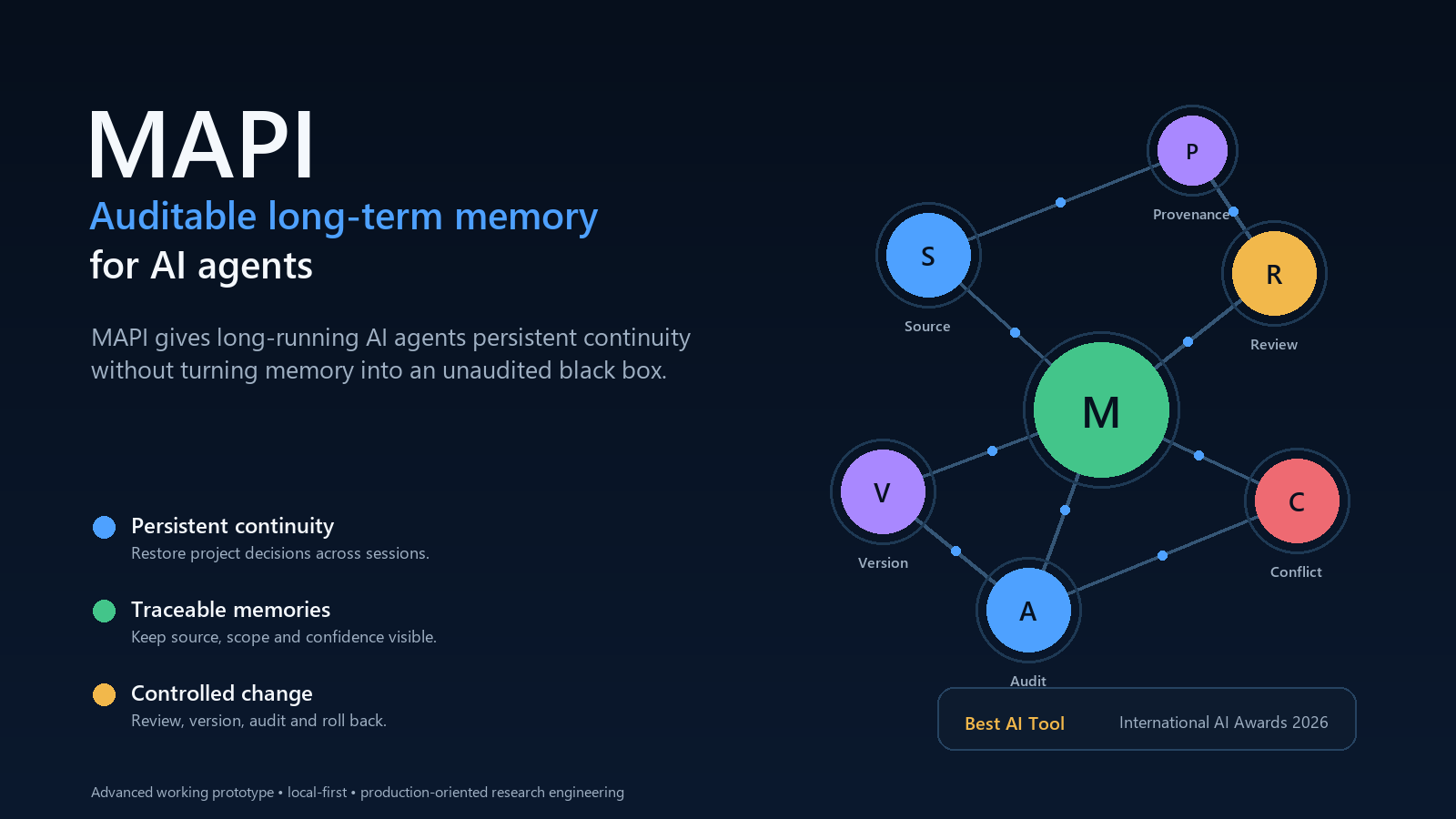
Why MAPI
AI agents can retrieve similar text, replay conversation history or load a summary. Long-running work needs more: decisions become scattered, summaries can mix facts with interpretation, and retrieval can surface an obsolete policy without knowing that it was replaced.
Not every message deserves durable storage.
A memory needs provenance, scope and confidence, not only text.
New decisions should not silently erase their predecessors.
The system should surface uncertainty instead of inventing certainty.
MAPI is not another memory database. It is a control layer for deciding what an AI agent should remember, why that memory is trusted and how it can safely change over time.
Three pillars
Restore important decisions, constraints and open questions across sessions without replaying an entire conversation history.
Keep source, project scope, confidence, ownership and lifecycle state visible alongside remembered content.
Review candidates, preserve decision lineage, surface conflicts and inspect supported changes through preview, audit and rollback workflows.
How it works
An agent or integration proposes candidate memories from current work.
A human or operator decides what deserves durable storage.
Confirmed memories retain source, scope, confidence, ownership and lifecycle state.
A future session retrieves only the relevant project context.
Changed decisions are versioned; contradictions remain visible until reviewed.
Supported operations can be previewed, recorded and evaluated through rollback previews.
Synthetic local demonstration
The demonstration uses a completely synthetic project called Northstar Booking, a fictional product owner named Alex Morgan and a fictional AI assistant named Nova.
These are screenshots of an isolated deterministic demo. No private memories are present, and the local demo server is not publicly hosted.
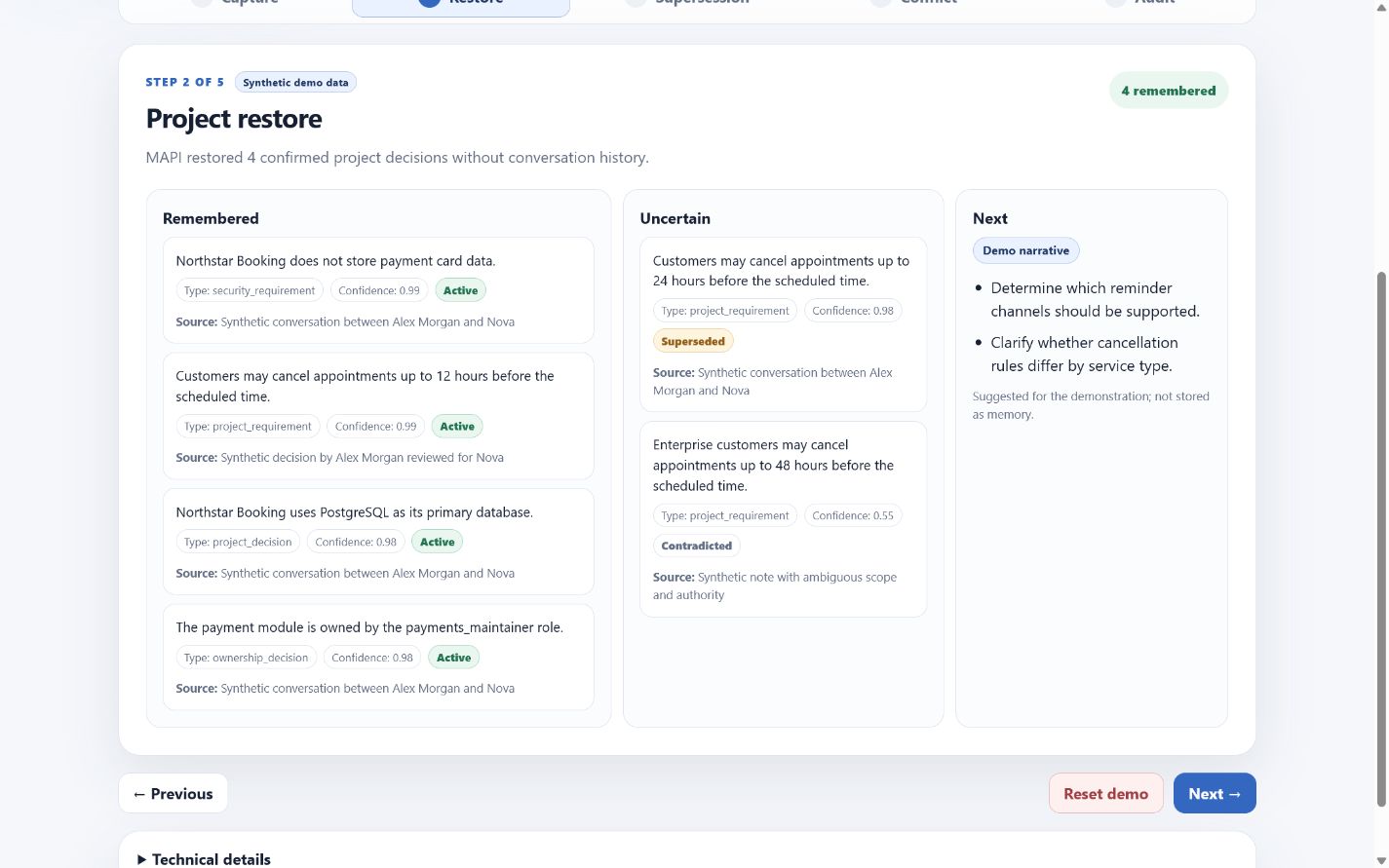
Demo view 1
A new session restores confirmed constraints while facts, uncertainty and next steps remain separated.
Open screenshot at full size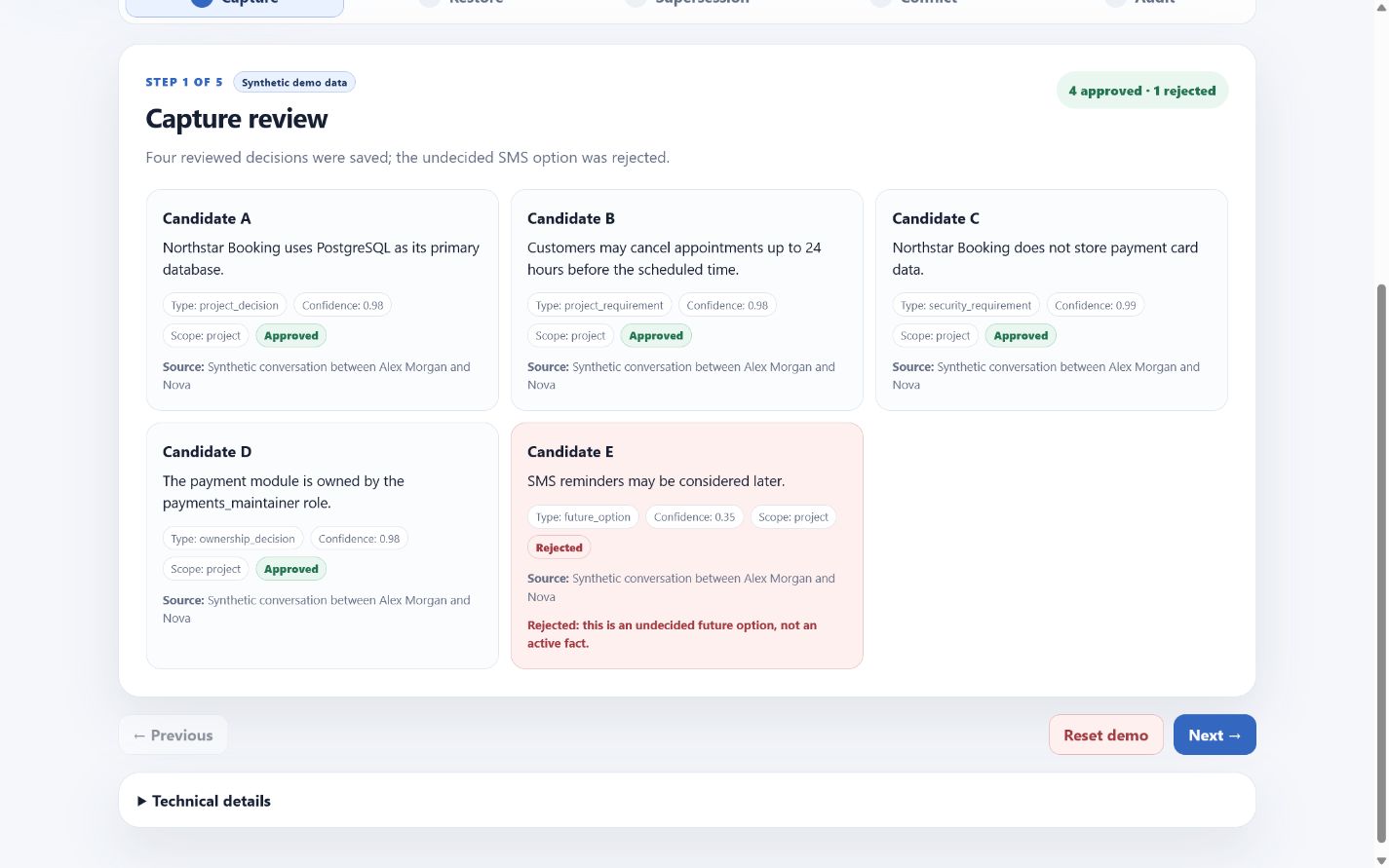
Demo view 2
Four confirmed project decisions are approved; an undecided SMS idea is rejected before durable storage.
Open screenshot at full size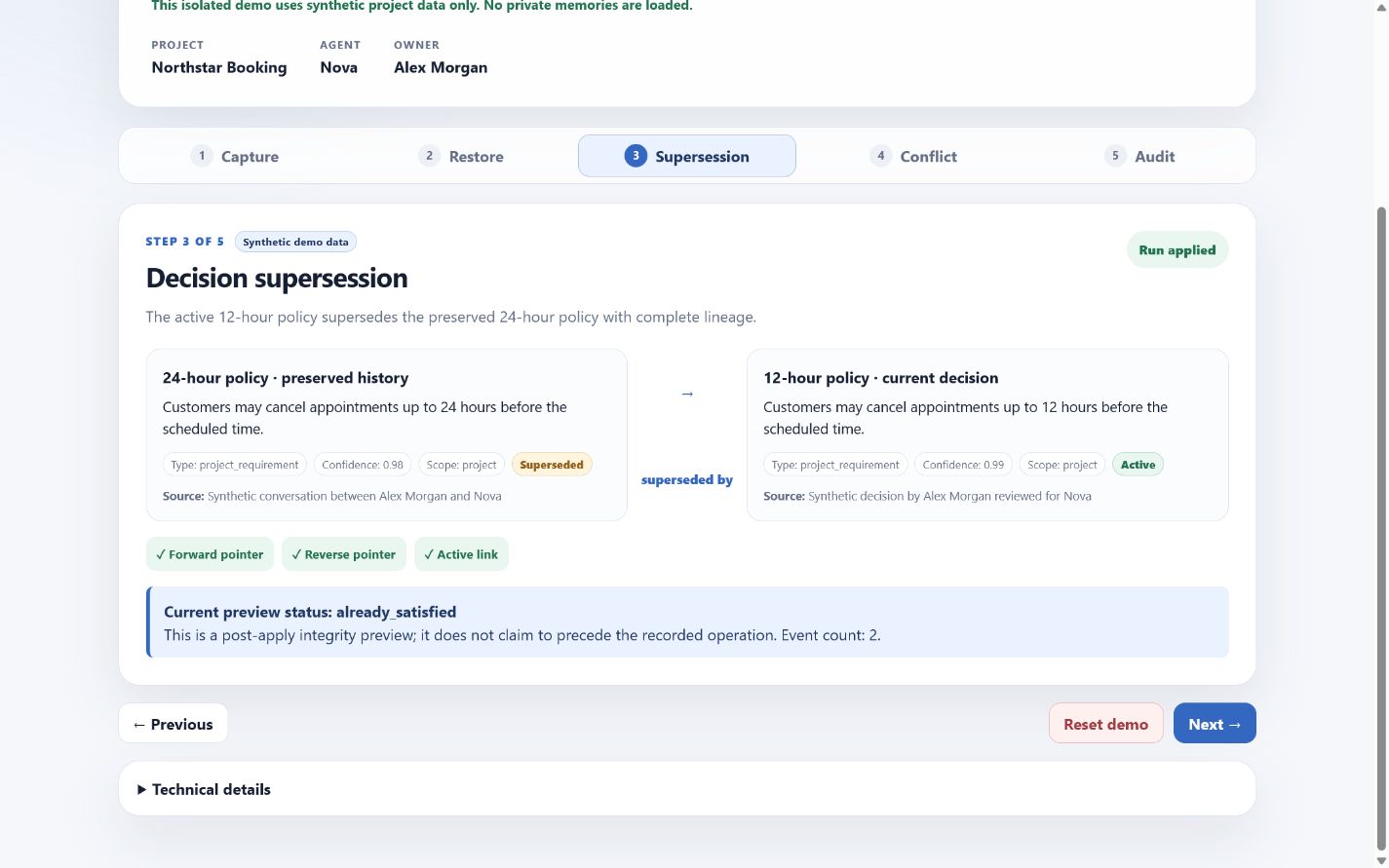
Demo view 3
The 12-hour rule becomes active while the previous 24-hour decision remains preserved as history.
Open screenshot at full size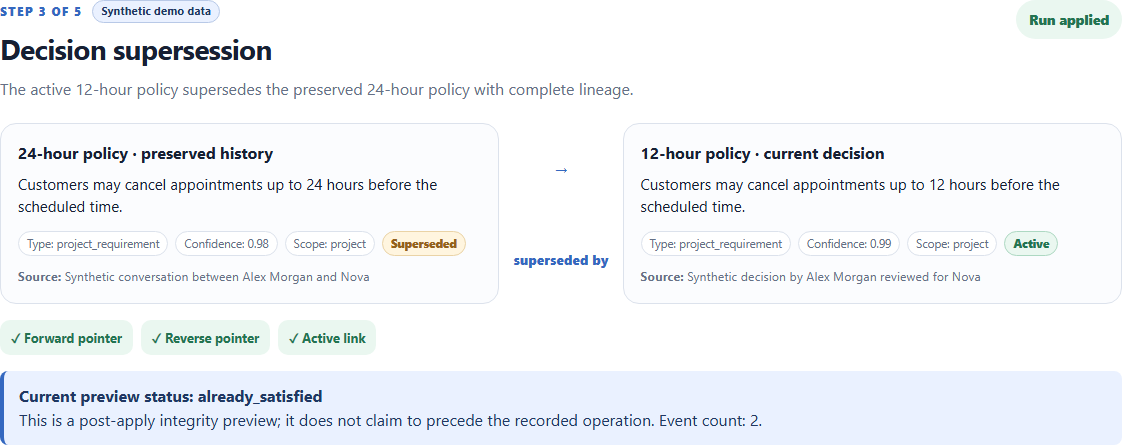
Demo view 4
Forward and reverse pointers connect both decision versions through an explicit active link.
Open screenshot at full size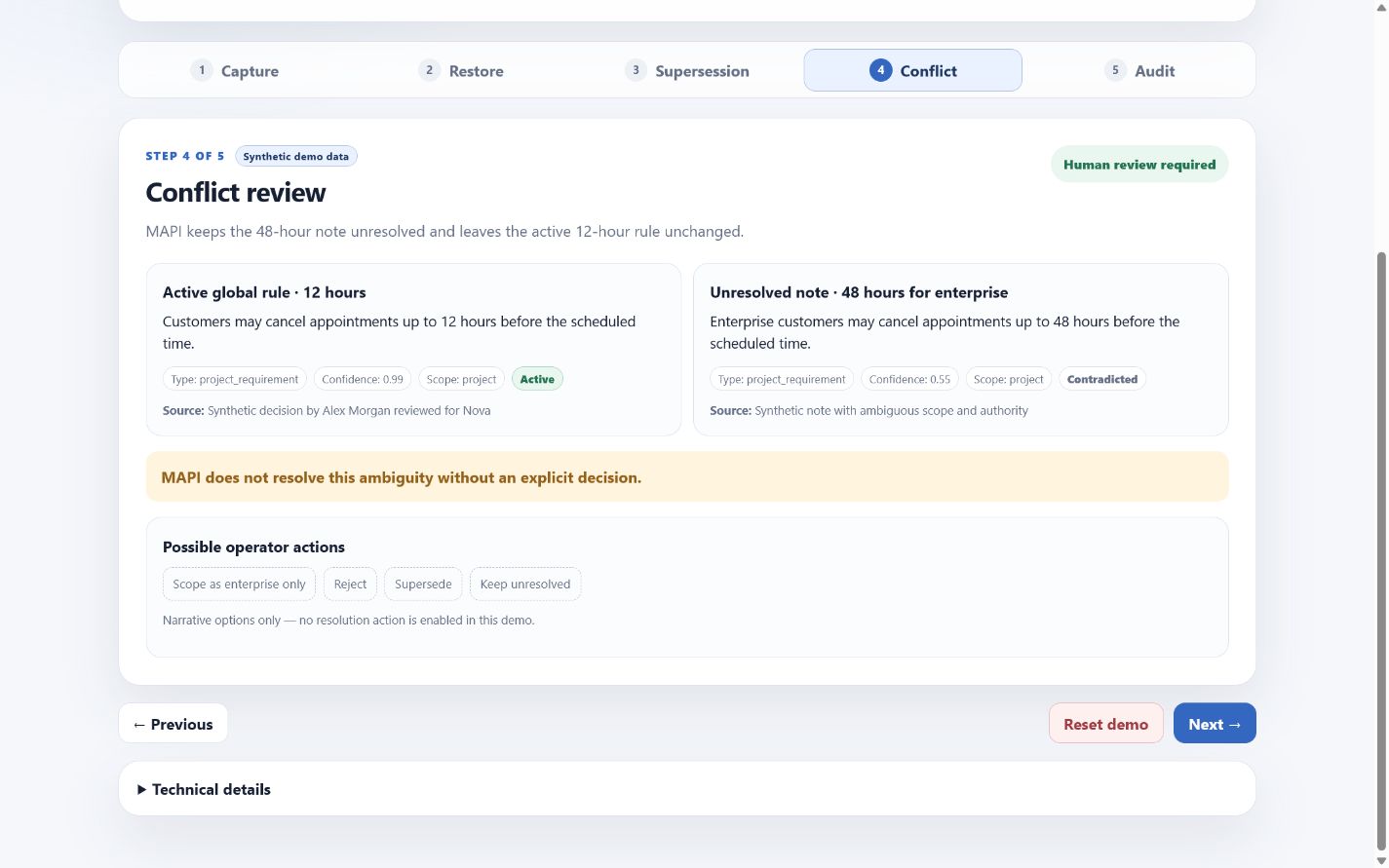
Demo view 5
A conflicting 48-hour enterprise note stays unresolved instead of being promoted to truth.
Open screenshot at full size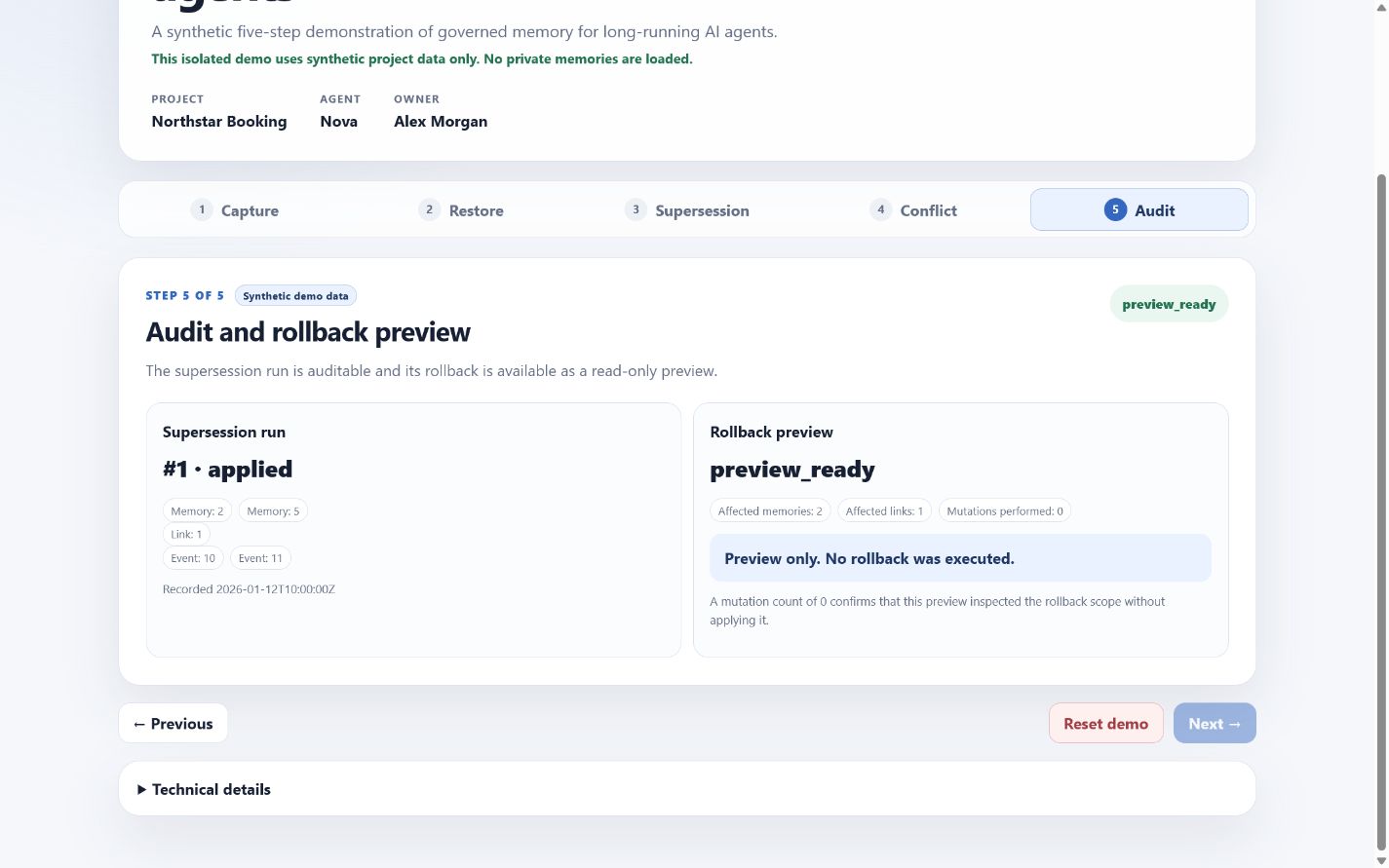
Demo view 6
The recorded run exposes affected items; rollback preview inspects the reversal scope with zero mutation.
Open screenshot at full sizeReproducible proofs
MAPI includes deterministic, reproducible scenarios for decision supersession and conflicting-source provenance. They use synthetic data and run without an external language model.
Proof 1
A project first uses SQLite and later changes the decision to PostgreSQL. MAPI returns PostgreSQL as the current state while preserving the earlier SQLite decision and the relationship between them.
Proof 2
Two sources provide different values for the same project fact. MAPI preserves both records and their provenance, and exposes the conflict instead of silently choosing one version.
Architecture
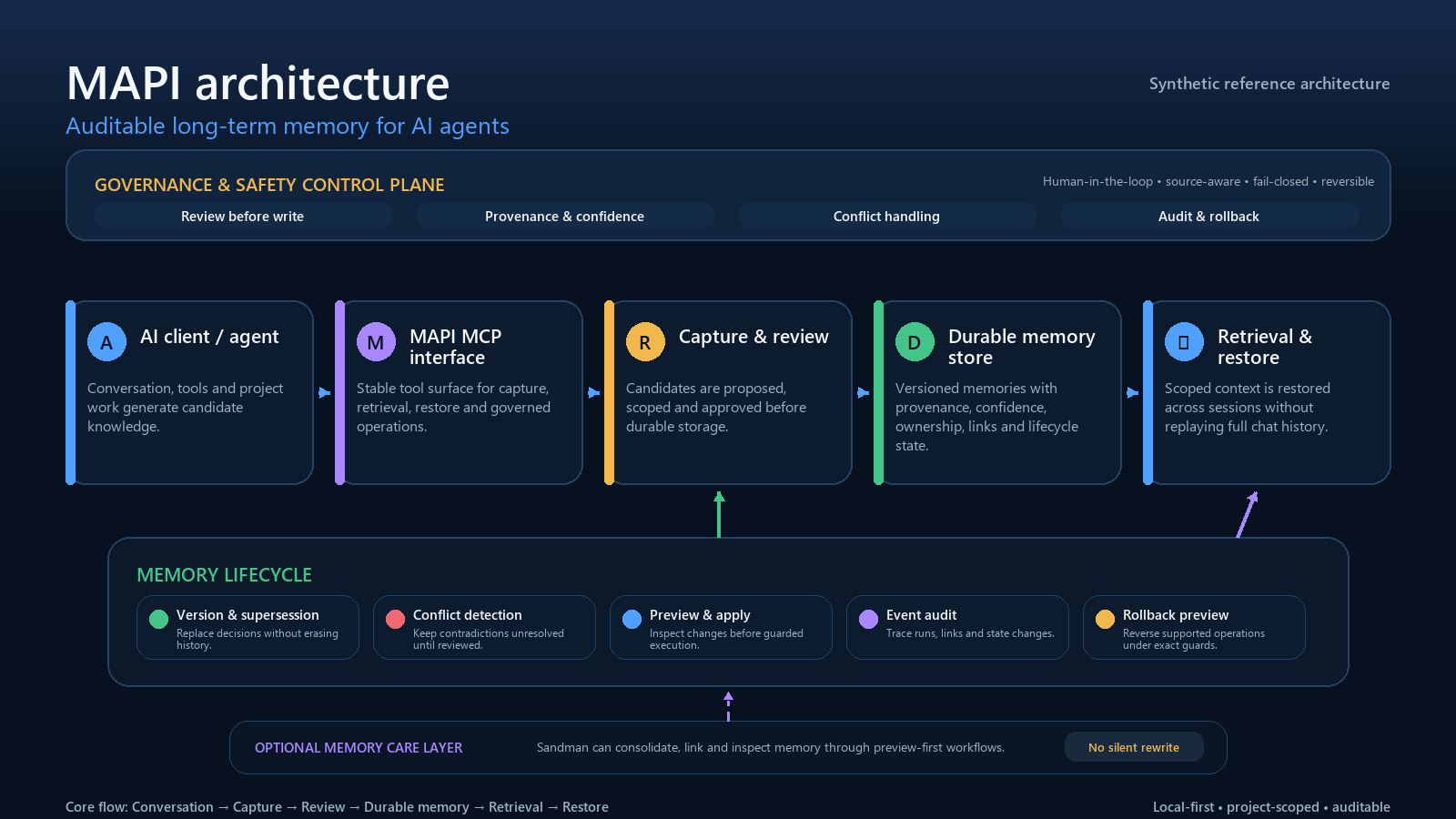
MAPI exposes a stable MCP and API tool surface for capture, retrieval, restore and governed lifecycle operations. The durable store keeps content together with provenance, scope, confidence, ownership, links and lifecycle state.
MAPI can complement semantic retrieval, RAG and vector databases. It does not replace them; it governs the durable memory they may later expose to an agent.
 Open the architecture diagram at full size
Comparison
| Approach | Useful for | Usually does not manage |
|---|---|---|
| Vector store | Semantic similarity search | Lifecycle, review, conflicts and audit |
| RAG | Adding external context to a model request | Durable decision governance and lineage |
| Chat history | Preserving the raw conversation | Active project memory and explicit state |
| Automatic summaries | Compressing long exchanges | Provenance and separation of fact from interpretation |
| MEMORY.md | A simple human-readable record | Scale, scope, confidence and controlled updates |
| MAPI | Governed durable memory and continuity | Still requires technical integration and onboarding |
MAPI works alongside retrieval systems. It controls how long-term agent memory is selected, trusted and changed.
Intended users
Preserve architectural decisions, constraints, ownership and unresolved questions across implementation cycles.
Give cooperating agents a shared but governed memory layer instead of an uncontrolled pool of summaries.
Keep durable memory under operator control and restore only the required project scope.
Add provenance, explicit lifecycle states, conflict visibility and auditable changes.
Explore persistent agent continuity without treating similarity as a complete memory model.
Responsible claims
MAPI provides a more inspectable foundation for long-term context. Memory quality still depends on source quality, capture rules, operator decisions and client integration.
Deployment variants
The memory and governance model stays shared. What changes is where MAPI runs and how it is operated.
Server variant · controlled developer preview
A working server variant for organizations that need a persistent remote MCP endpoint on their own VPS. It includes authenticated remote access, onboarding, backups, maintenance and controlled server deployment, but it is not presented as a mass-market SaaS.
Local variant · alpha
A local Windows package being prepared for simpler installation and use on the operator's own computer. Packaging, installer work and user validation are still in progress.
Project status
MAPI Core is a Public Release Candidate / Developer Preview. Polaris / MAPI VPS is a working controlled developer-preview deployment, while MAPI Windows remains in alpha during packaging, installer work and user validation.
The two variants share the memory model, but their deployment and operating boundaries are different.
License and deployment
MAPI Core is open source under the Apache 2.0 license. MorenaTech's price from PLN 3,500 + VAT is for a scoped deployment service, not for access to the repository. Depending on the agreed scope, the service can include installation, configuration, secure endpoint and access setup, MCP integration with a selected AI client, onboarding, launch tests and agreed support.
Creator
MAPI was created by Michał Chlewicki, a software tester and automation engineer with professional experience dating back to 2011, including eight years at Intel.
His quality-assurance background shaped the project around traceability, failure analysis, explicit state transitions and controlled changes rather than opaque automation.
Review the project materials or contact MorenaTech about MAPI and governed agent-memory infrastructure.
Related materials
These links come from MorenaTech's explicit content graph and lead to materials in the same area.